
How Do Microgrids Work?
A microgrid can function either as a sub-grid connected with the power grid or as a self-sustaining system separate from the power grid. The application of microgrids has recently gained popularity as people have been searching for ways to get more flexible and efficient use of power. To analyze the functionality of a microgrid, it is appropriate to examine the elements of a microgrid.
In fact, within a few minutes following a blackout or a grid disturbance, an intelligent microgrid system can act on its own. This has not been designed to happen. This outcome has been achieved through careful system design integration between generation, energy storage, and control.
What a microgrid actually is
At its core, a microgrid is defined by two characteristics: locality and controllability. It serves a defined area, such as a hospital, military base, industrial site, or neighborhood, and it has the technical ability to manage power flows internally.
The U.S. Department of Energy’s publication Microgrids explains that a microgrid integrates electricity generation, loads, and often energy storage within clearly defined electrical boundaries, allowing it to operate as a single controllable entity. This definition highlights an important point: a microgrid is not just equipment, but a system designed to act in a coordinated way.
Core components of a microgrid
Every microgrid is constructed from the same basic building blocks, although their scale and complexity can vary very much.
Distributed energy resources
Distributed energy resources, also referred to as DERs, are essentially the sources of electric power that are contained within the microgrid. These may be in the form of solar photovoltaic cells, wind energy turbines, natural gas-based electric power generators, fuel cells, or combined heat and power producers.
It is not the type of technology that is significant but that production occurs close to where the electricity is consumed. This cuts down transmission losses and improves efficiency.
Loads and critical demand
Loads are those devices and systems which consume electricity. Microgrid loads are typically priority-based loads. Critical loads are those that require uninterrupted power supply; examples are hospital equipment and data centers. Non-critical loads can be curtailed when generation is limited.
It is this ability to prioritize its needs that makes a microgrid an attractive option for resilience planning.
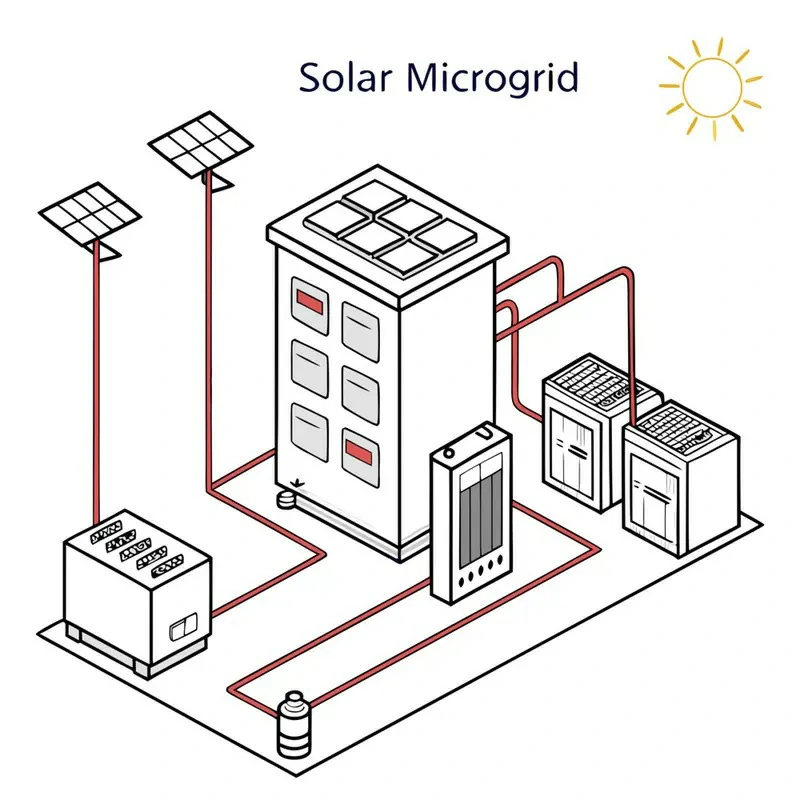
Microgrid energy storage
Microgrid energy storage is a key aspect of how microgrids operate on a day-to-day basis. Battery storage is the most common means of microgrid energy storage, although other concepts, such as heat storage and flywheels, are also applicable.
Energy storage systems absorb excess electricity generated in a situation where supply overshoots demand, and supply drops or the demand peaks. Energy storage systems work in a solar power microgrid to regulate the natural variability of solar radiation.
Microgrid energy management system
The microgrid energy management system, sometimes called a controller, represents the “brain” of the system. It monitors generation, storage, and loads in real time and can make decisions on how the system should operate.
It is this control layer that enables a microgrid to balance power internally, respond to disturbances, and coordinate with the main grid.
How microgrids operate with the main grid
Because a microgrid is designed to operate in more than one mode, operating mode flexibility is the defining characteristic.
Grid-connected operation
Most of the time, the microgrid operates while still connected to the greater utility grid. While in this configuration, it can import electricity when that is less expensive or more reliable, and export power in excess of demand whenever local generation exceeds consumption.
The microgrid energy management system continuously evaluates price signals, load conditions, and generation availability to determine the most efficient operating strategy.
Islanded operation
When a disturbance occurs on the main grid, such as a storm or equipment failure, a microgrid can disconnect and operate in “island mode.” This transition can happen automatically and within fractions of a second.
The U.S. Department of Energy’s publication Microgrid and Integrated Systems Program Report demonstrates that advanced microgrid systems are designed to maintain stable operation during islanding by coordinating local generation, energy storage, and load management. This capability is what allows critical facilities to continue operating even when the broader grid is unavailable.
The role of control and communication
Control and communication systems can be much less visible than photo voltaic panels or batteries but are equally important.
Sensing and monitoring
Voltage, current, frequency, and power quality are measured by sensors throughout the microgrid. This feeds into the control system to give a real-time picture of system conditions.
Without accurate sensing, a microgrid is not able to respond effectively in case of rapid changes either on the load or generation side.
Decision-making and automation
The microgrid energy management system works based on sensor data, such as charging or discharging storage, starting or stopping generators, or shedding non-critical loads. There are many autonomous decision-making processes that let the system respond faster than a human would.
The need for automation is most urgent in the instance of a problem or a disruption when the stability must be restored immediately.
Why energy storage is so important
Energy storage deserves special attention because it ties together many aspects of microgrid operation.
The response capacity offered by energy storage helps to stabilize the system against any fluctuations concerning frequency and voltage. The system further helps to make the transition between islanded modes and grid-tied modes smoother. The reason for implementing energy storage systems within renewable energy resources-rich microgrid models lies in their ability to ensure stability.
In terms of operations, storage enables a group of generation resources to be made into a flexible system. This is because, rather than having generation and demand exactly balance at all times, energy is able to be moved through time.
Typical applications of microgrids
Microgrids do not belong to or apply in one sector only. Microgrids have many usages due to their versatility.
Critical infrastructure
Hospitals, shelters, and military bases use micro-grids to maintain their operations. For such consumers, the availability of services is of high importance as compared to the cost.
Campuses and Industry Settings
Microgrids are being employed as means of managing energy expenditure by universities, business campuses, and factories. Microgrids, in such scenarios, are becoming integral components of the overall plan for energy management.
Communities and rural zones
Microgrids can also serve as a source of power in remote areas where extending a grid is unpractical or unavailable. This isn’t just a contingency plan but a source of power in remote areas in and of itself.
How microgrids differ from traditional backup systems
One is almost tempted to equate micro-grids to sophisticated versions of traditional back-up power generators. However, this would be quite inaccurate.
Conventional backup power sources are reactive. They are switched on only when there is a failure. Microgrids, on the other hand, run all the time, optimizing energy consumption. This happens even when everything was working normally.
As an integrated solution, microgrids are capable of ensuring economic, environmental, as well as reliability benefits concurrently.
Main factors to consider in microgrid design
The design of a microgrid does not require a technical background. It needs proper planning.
It is upon the developers to determine what loads should be considered critical, the level of resilience that is desired, and the amount of renewables and storage that needs to be incorporated. Standards imposed by the regulatory bodies, as well as the guidelines for interconnecting with the utilities, also have a role.
The US Department of Energy reports that successful microgrid demonstrations balance technical systems with operational requirements and priorities, and do not prioritize technology for its own sake.
Conclusion
Therefore, how exactly do microgrids operate? The key is in combining local energy, energy storage systems for microgrids, and an intelligent microgrid energy management system into an overall system that is flexible, depending on the circumstances. Grid-connected or islanded, the microgrid is constantly balancing supply against demand through real-time feedback data.
However, the best way to move forward from the establishment of goals is to identify whether the purpose of the microgrid implementation will be optimization of resilience, optimization of expenses, optimization of sustainability, or a combination of the three. Once a goal is established, the task of ensuring that the microgrid implementation adds functionality rather than complexity will become much easier.