
How to Choose the Right Energy Cabinet for Your Home
Selecting the proper energy cabinet for a household system is about more than technical specifications; it will be essential for the security of your setup as well as its efficiency and reliability in the long term.
Definition and importance of energy cabinets
Energy cabinets are enclosures that are used for the storage of energy storage systems such as batteries, controls, and other necessary devices. When used in a household setting, the energy cabinet essentially is also a battery cabinet, especially in the context of solar energy systems with storage capacity.
The importance lies in the sensitivity of energy storage systems and their specific requirements that could be compromised if the wrong cabinet was installed.
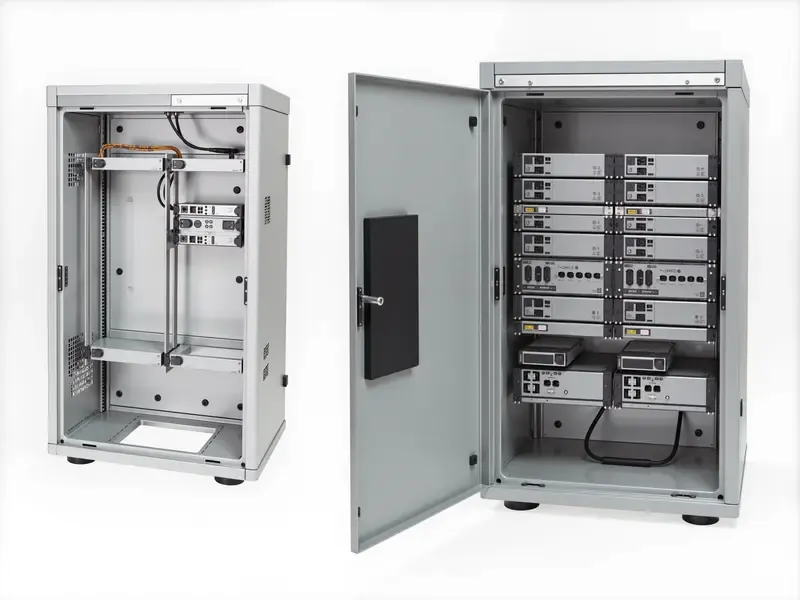
Key criteria for choosing an energy cabinet
Safety design comes first
The study titled Energy Storage Systems Safety Roadmap, published by Sandia National Laboratories, shows that enclosure design, thermal management, and fault containment are critical to preventing cascading failures in battery systems.
In practical terms, this would entail the following:
- Fire-resistant material is necessary
- Adequate ventilation or cooling is necessary
- Internal separation of parts will limit risk spreading
If these criteria are not satisfied within a certain cabinet, then it should be ignored.
Indoor versus outdoor cabinet installation specifications
All cabinets are not the same; not all can be used in every situation. Many people fail to realize this fact.
Indoor cabinets:
- Emphasize space efficiency and quiet operation
- Need less intense weather protection
- Must connect with residential electricity systems
Outdoor cabinets, including outdoor telecom cabinets, on the other hand:
- Need to be weather resistant
- Require temperature management at wider extremes
- Will have security considerations
In any case, when you use a system outdoors even partially, it should be considered outdoor use.
Battery compatibility and system size
But not all battery enclosures are suited for all batteries – a point which sounds self-evident but is quite often overlooked.
The following must be taken into consideration:
- Type of battery (lithium-ion, LFP, etc.)
- Physical dimensions and mounting configuration
- Scalability
An energy enclosure must have some scalability options; otherwise, it can limit the functionality of your system in just a couple of years.
Passive and active thermal management
Temperature is one of the major elements affecting battery performance.
Passive thermal management:
- Utilizes only air circulation and proper spacing between the modules
- Inexpensive and with less mechanical components
- Suits moderate climates or low-capacity systems
Active thermal management:
- Uses fans or even HVAC-like solutions
- Recommended for large capacity or outside use
- Expensive and more complicated, but much safer
In case your battery pack needs to operate under high temperatures or is subject to frequent discharges/chargers, then the active approach is advisable.
Comparing cabinet types for home use
| Feature | Energy Cabinet (General) | Battery Cabinet | Outdoor Telecom Cabinet |
| Primary use | Energy storage systems | Battery housing | Telecom + power systems |
| Environment | Indoor / controlled | Indoor mostly | Outdoor / harsh conditions |
| Cooling | Passive or active | Mostly passive | Often active |
| Protection level | Moderate | Moderate | High (IP-rated) |
| Expansion | Often modular | Limited to battery design | Highly modular |
Here lies the important difference between these terms, as these terms can be used interchangeably. However, it will cause you to either overpay for your cabinet or provide inadequate protection for your system.
How to match the cabinet to your home setup
Small backup systems (residential use)
If you are planning a small-scale backup system:
- A smaller cabinet should be enough
- Installation simplicity and low-maintenance are essential
- Noise levels are also important if placed inside
Solar and energy storage systems
For users of solar energy systems:
- Choose an energy cabinet that is expandable
- Ensure compatibility with inverter systems
- Optimal thermal control due to regular start-ups
Outdoor and partially exposed setups
If your system is installed in your garage, on exterior walls, or in your yard:
- Outdoor cabinets, similar to those used for telecoms, might be ideal
- Ensure sealing and thermal control
- Corrosion resistance should be considered
Common mistakes to avoid
Choosing based on price alone
Inexpensive cabinets tend to compromise on:
- Quality of materials
- Heat dissipation
- Safety isolation
And this is likely to lead to additional expenses either through maintenance problems or outright system breakdown.
Disregarding proper airflow and spacing
A good quality cabinet can still become ineffective in the event of poor installation.
It is important to:
- Install cabinets in spacious areas
- Make sure there is sufficient air intake and exhaust
- Leave enough space for future upgrades
Overlooking future expansion
Energy needs rarely stay constant.
When a cabinet is unable to:
- Increase its capacity
- Take care of any added weight
- Accommodate additional parts
A practical way to decide
In simplification of the decision process, there are actually only three things to decide upon:
- Where do you plan on installing the cabinet? (inside/outside)
- How much energy capacity do you require in both present and future scenarios?
- What safety and thermal standards do you require from your energy cabinet?
The answer to all of these questions can dramatically reduce the number of alternatives available to you.
Closing thoughts on the decision-making process
Choosing an energy cabinet is far more than just picking an item. Instead, the choice must be made to lay the groundwork for your whole energy setup.
In doubt, opt for safety and scalability at the expense of initial costs. A well-chosen energy cabinet ensures longevity of your energy setup and its optimal functioning.